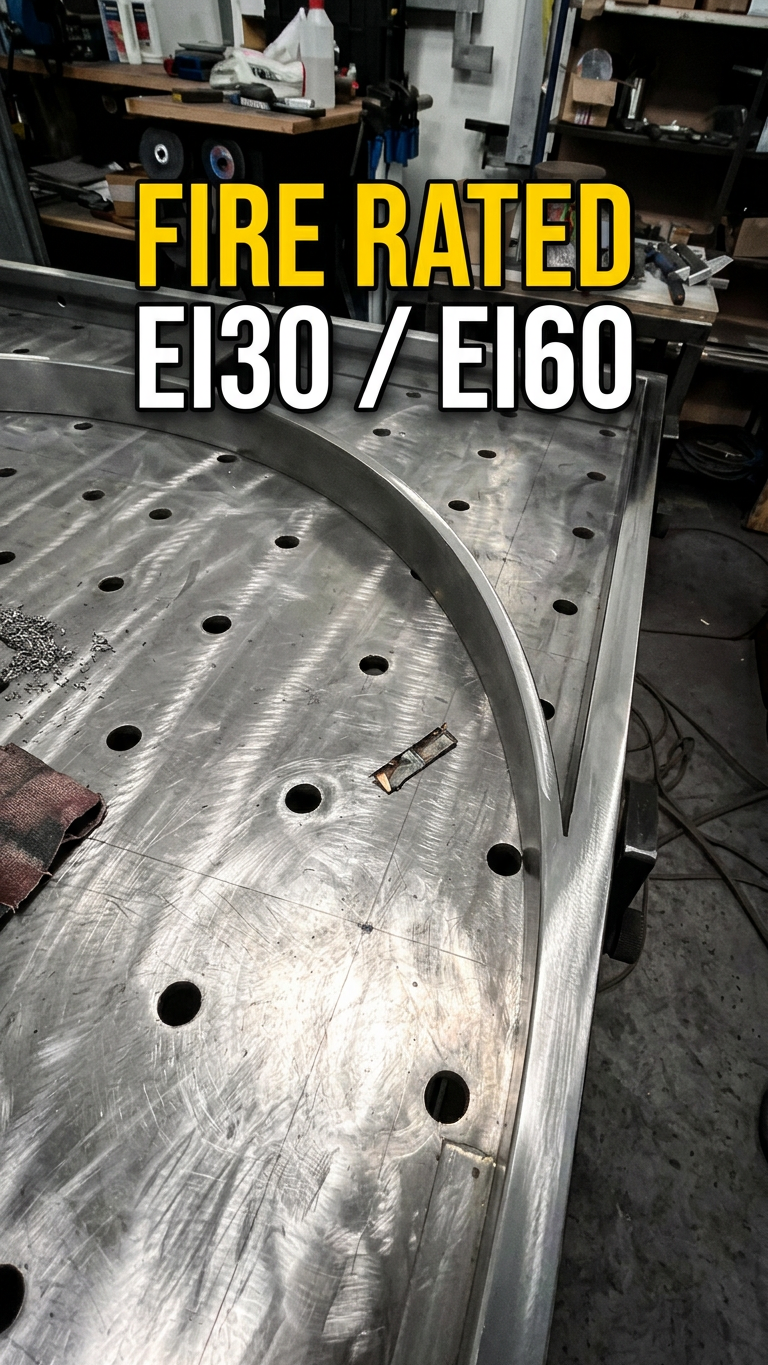
Choosing the right fire door is one of the decisions that can make or break a building project. Specify a rating that is too low and the project fails Building Control sign-off – or worse, puts lives at risk. Specify too high and you add unnecessary cost, weight and lead time to every opening.
For contractors, developers, architects and distributors working in the UK, the question usually comes down to this: EI30 or EI60? And how do these European classifications relate to the familiar FD30 and FD60 ratings used across Britain?
In this guide, we explain the difference in plain English, show where each rating is typically used, and share what to look for when sourcing fire rated doors directly from a manufacturer.
About the author: Portamet is a European manufacturer of fire rated steel doors, producing EI30, EI60 and EI90 fire doors and fixed fire-resistant panels up to EI120, as well as E-rated (integrity-only) doors – commonly known in the UK as FD30 and FD60. Our products hold full Warrington Fire certification for the UK market, and have also successfully passed fire testing at an accredited laboratory in the United States.
What Do "E", "I" and the Numbers Actually Mean?
European fire door ratings are classified under EN 13501-2, based on testing to EN 1634-1. Each letter describes a performance criterion, and the number states for how many minutes that criterion is maintained.
| Symbol | Criterion | What it means in practice |
|---|---|---|
| E | Integrity | The door stops flames and hot gases passing through to the protected side. |
| I | Insulation | The unexposed face of the door stays cool enough (average temperature rise limited) that it does not ignite materials or harm people nearby. |
| W | Radiation | Limits heat radiated from the unexposed face (relevant mainly to glazed elements). |
| S (Sa / S200) | Smoke control | Limits the leakage of cold and/or hot smoke. |
| C | Self-closing | The door reliably closes on its own (often with a durability class, e.g. C5). |
So:
- EI30 = integrity and insulation for at least 30 minutes.
- EI60 = integrity and insulation for at least 60 minutes.
- E30 / E60 = integrity only, without the insulation requirement.
How Do EI Ratings Compare to FD30 and FD60?
In the UK you will still see the traditional FD ratings everywhere – in Approved Document B, on drawings and in door schedules. "FD" ratings come from testing to BS 476-22 and refer to integrity (the "E" criterion). The suffix "S" – as in FD30S – means the door also limits smoke leakage.
A simplified comparison:
| UK designation | Closest European equivalent | Insulation (I)? |
|---|---|---|
| FD30 / FD30S | E30 / E30Sa | Not required |
| FD60 / FD60S | E60 / E60Sa | Not required |
| — | EI30 | Yes |
| — | EI60 | Yes |
The key takeaway: an EI30 door meets and exceeds the integrity requirement of an FD30 door, because it also provides insulation. The same logic applies to EI60 versus FD60. That is why EI doors are often chosen where the extra thermal protection matters – or where the project specification calls for European classification.
Portamet manufactures both families:
- E-rated doors (FD30, FD60) – a cost-effective solution where integrity is what the regulations ask for.
- EI-rated fire doors (EI30, EI60, EI90) – where integrity and insulation are required.
- Fixed fire-resistant panels and screens up to EI120 – for partitions, borrowed lights and fixed elements in compartment walls.
See the full range of Portamet fire rated steel doors.
This means one supplier can cover the full door schedule of a project, from apartment entrance doors to plant rooms and compartment walls.
EI30 Fire Doors – Where Are They Typically Used?
A 30-minute fire door is the most common fire door in UK buildings. Typical applications include:
- Flat entrance doors in residential blocks (usually specified as FD30S or EI30 with smoke seals)
- Doors onto protected corridors and escape routes
- Hotel bedroom doors and doors in student accommodation
- Office and commercial premises – corridor and lobby doors
- Doors between a dwelling and an integral garage
- Cupboards and risers in lower-rise buildings, where 30 minutes is sufficient
Choose EI30 when: the fire strategy calls for 30 minutes and you want insulation on top of integrity – for example where people may be close to the door during evacuation, or where combustible materials may be stored next to it.
EI60 Fire Doors – Where Are They Typically Used?
A 60-minute fire door is used where the risk is higher, where the building is taller or where the door sits in a wall with a higher fire resistance. Typical applications include:
- Doors in 60-minute compartment walls – under Approved Document B, a door in a compartment wall generally needs the same fire resistance as the wall itself
- Plant rooms, boiler rooms, electrical and switch rooms
- Refuse and bin stores, storage rooms and archives
- Stair cores and protected shafts in mid- and high-rise buildings
- Healthcare, education and industrial buildings, where the fire strategy requires longer protection
- Car park access doors and doors between different building uses (e.g. retail at ground level, residential above)
Choose EI60 when: the fire strategy, the wall rating or the use of the space requires 60 minutes of protection – or when you want added resilience in high-occupancy and high-risk areas.
When Do You Need EI90 or EI120?
Some projects go beyond 60 minutes – for example industrial facilities, data centres, energy infrastructure, large logistics buildings and complex mixed-use developments. For these, Portamet offers:
- EI90 fire doors – for 90-minute compartmentation
- Fixed fire-rated panels and screens up to EI120 – for walls and partitions where the highest level of fire separation is required
EI30 vs EI60 at a Glance
| EI30 | EI60 | |
|---|---|---|
| Fire resistance | 30 minutes integrity + insulation | 60 minutes integrity + insulation |
| Typical UK equivalent (integrity) | FD30 / FD30S | FD60 / FD60S |
| Common uses | Flat entrances, corridors, hotel rooms, offices | Compartment walls, plant rooms, stair cores, high-risk areas |
| Door construction | Lighter, slimmer leaf | Thicker leaf, more insulation, heavier hardware |
| Cost | Lower | Higher |
| When to choose | Fire strategy requires 30 min | Fire strategy or wall rating requires 60 min |
How to Decide: A Practical Checklist
- Start with the fire strategy. The fire engineer's report and Approved Document B (or the relevant guidance for Scotland, Wales or Northern Ireland) define what each opening needs.
- Check the rating of the wall. A door in a compartment wall usually needs to match the wall; doors in protected shafts may require a different period.
- Confirm whether insulation (I) is required. If yes, you need an EI door – an FD/E door will not be enough.
- Check smoke control. Doors on escape routes and flat entrances typically need smoke seals (the "S" suffix).
- Consider the full doorset. The rating only applies to the tested and certified doorset – leaf, frame, seals, glazing, hinges, closers and locks working together.
- Ask for third-party certification. In the UK, look for independent certification from a recognised body such as Warrington Fire.
- Plan for maintenance. Under the Fire Safety (England) Regulations 2022, fire doors in multi-occupied residential buildings must be checked regularly, and the Building Safety Act 2022 has raised the bar for product traceability and the "golden thread" of information – especially in higher-risk buildings.
When in doubt, do not downgrade. Always confirm the final specification with the project's fire engineer or Building Control.
Why Certification Matters More Than Ever in the UK
Since the Building Safety Act, UK contractors and developers are under much greater scrutiny for the products they install. A fire door is only as good as the evidence behind it. This is why buyers increasingly expect:
- Third-party certification of the complete doorset, not just a test report
- Traceable labelling on every door
- Clear installation and maintenance instructions
- Documentation ready for the golden thread and handover packs
Portamet fire doors hold full Warrington Fire certification for the UK market, which means they can be specified and supplied for projects across Great Britain with the documentation UK Building Control and fire engineers expect.
Tested for the UK – and for the United States
Beyond the UK, Portamet has successfully completed fire testing at an accredited laboratory in the United States, opening the way to supply fire doors to the American market as well. For international developers, contractors and distributors, this means working with one manufacturer whose products are proven against the requirements of different regulatory systems.
Why UK Companies Source Fire Doors from a Manufacturer in Poland
Poland has become one of Europe's leading hubs for door and building product manufacturing, and more UK companies are buying directly from Polish manufacturers instead of through multiple intermediaries. The main reasons:
- Competitive factory pricing – buying direct from the manufacturer removes extra margins in the supply chain.
- Full product range from one source – FD30, FD60, EI30, EI60, EI90 and fixed panels up to EI120 under one roof.
- Made-to-measure production – non-standard sizes, single and double leaf, glazed and solid options matched to your door schedule.
- Project volumes – capacity to handle repeat orders and large residential, commercial and industrial projects.
- Short logistics routes – regular road transport from Poland to the UK makes delivery planning predictable.
- Certified for the UK – Warrington Fire certification means you are not compromising on compliance by buying from abroad.
Who We Work With
Portamet supplies fire rated doors to B2B customers, including:
- Main contractors and fit-out contractors
- Residential and commercial developers
- Door and ironmongery distributors and wholesalers
- Joinery companies and installers
- Architects and specifiers looking for a reliable manufacturer for their projects
Frequently Asked Questions
Is an EI30 door the same as an FD30 door?
Not exactly. FD30 (BS 476-22) is an integrity rating, closest to European E30. EI30 adds insulation, so it offers a higher level of performance. An EI30 door satisfies the integrity requirement of an FD30 door, but not every FD30 door would achieve EI30.
Can I use an EI60 door where EI30 is specified?
In terms of fire performance, yes – a higher rating meets a lower requirement. However, EI60 doors are heavier, thicker and more expensive, so it is usually more efficient to specify exactly what the fire strategy requires. Always confirm with the fire engineer, especially for smoke control and hardware.
What does the "S" in FD30S mean?
"S" indicates smoke control – the door limits cold smoke leakage, typically using smoke seals. In European classification, this is shown as Sa or S200.
Are fire doors from Poland compliant in the UK?
Yes – provided they carry the right evidence. Portamet fire doors hold full Warrington Fire certification for the UK market, so they can be supplied to projects throughout Great Britain.
Do you supply fire doors outside the UK?
Yes. In addition to the UK and EU, Portamet has successfully passed fire testing in an accredited US laboratory, enabling us to supply fire doors to the United States.
What is the highest fire rating Portamet offers?
We manufacture EI90 fire doors and fixed fire-resistant panels up to EI120.
Looking for a Reliable Fire Door Manufacturer for Your UK Projects?
Whether you need FD30 doors for a residential block, EI60 doors for plant rooms and compartment walls, or EI120 fixed screens for an industrial facility, Portamet can supply the complete package – certified, documented and manufactured to your schedule.
Send us your door schedule or drawings and we will prepare a quotation for your project.
👉 Explore our fire rated steel doors | See EI30, EI60, EI90 & EI120 fire doors