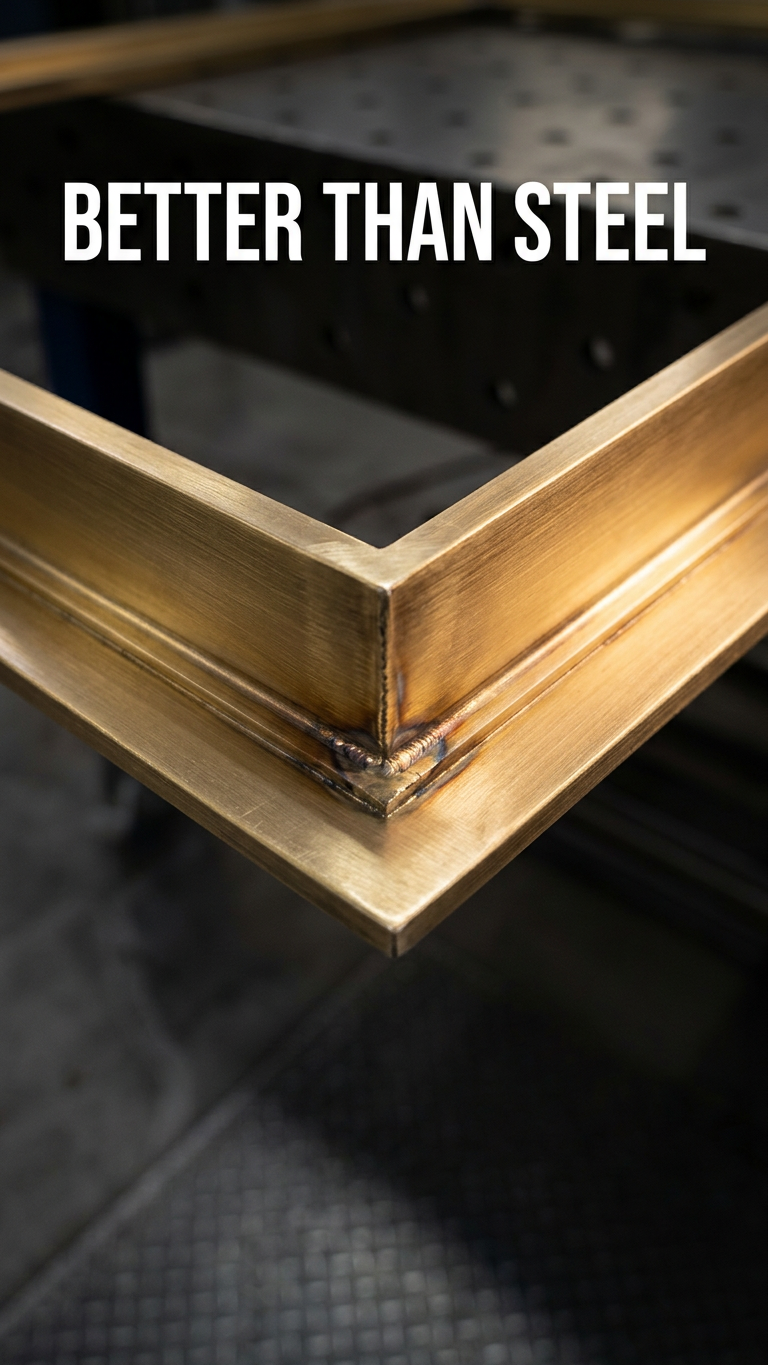
For more than a decade, one door has defined the modern interior: a slim black steel frame, a clean grid of glazing bars and a lot of glass. You have seen it in loft apartments in Berlin, townhouses in London, kitchens in Brooklyn and offices in Dubai. It is a good door. Black is still the standard finish on most of the steel doors we build in our factory in Gdańsk, Poland, and it will stay that way for a long time.
But something is changing in the projects that set the direction for everyone else. In private villas, boutique hotels, flagship stores and the best residential developments, architects and interior designers are asking for a different material. Not a new colour of paint. A different metal: real architectural bronze.
This article explains why. We look at how black steel became the default, why designers are starting to look past it, what architectural bronze actually is, how it differs from a bronze-coloured coating, how it ages, what it costs you in planning and care, and how to specify a bronze door so that the finished piece looks the way you imagined it. At the end we show how we build bronze doors at Portamet and ship them to projects in Europe, North America and the Middle East.
[VIDEO: Architectural Bronze Steel Doors | Portamet — YouTube]
How black steel became the default
The black steel door has an interesting history. Its roots are in the steel windows of early twentieth-century factories, schools and warehouses: thin hot-rolled profiles, small panes of glass, everything painted dark to protect the metal. For decades nobody thought of these windows as luxury. They were practical.
Then the industrial building became a home. Old warehouses in New York, London and Amsterdam were converted into apartments, and the people who moved in kept the original steel windows because they were beautiful in a raw, honest way. Designers noticed. By the 2010s the "loft door", a black steel frame with a glass grid, had moved from converted warehouses into new-build apartments, suburban kitchens and hotel bathrooms. Interior magazines, Pinterest boards and Instagram feeds did the rest.
Black steel won for good reasons:
- It is graphic. A thin black line on a white wall reads clearly in every photo.
- It is neutral. Black goes with almost everything, from concrete to oak.
- It lets light through. Slim steel profiles carry large panes of glass, so a glazed door can separate a room without darkening it.
- It carries a story. Even in a brand-new building, a black steel door hints at industrial heritage.
At Portamet we have built our business on this door. We know exactly why it works. And because we build so many of them, we also see clearly when clients start to ask for something else.
Why designers are starting to look past black
No trend lasts forever, and success has a cost. When one look appears in every second project, it stops being special. Three things are happening at the same time.
First, black steel has become common. What used to be the signature of a design-led loft is now available in standard sizes at DIY stores. That is good for the market, but it is a problem for an architect who has to give a premium client something that feels unique. A door the client has already seen in a neighbour's kitchen does not feel like a design decision.
Second, interiors are getting warmer. The cool palette of grey, white and black that dominated the 2010s is giving way to warmer materials: walnut and smoked oak, travertine and warm limestone, terracotta, plaster, boucle, leather, linen. In these rooms a black frame can look harsh. It cuts a hard line through a soft space. Designers want a metal that belongs to the same warm family as the rest of the room.
Third, clients want materials that feel real. After years of laminates, printed "stone" and metal-effect foils, high-end clients are asking for the real thing: real stone, real wood, real metal. They want something that changes with time and with light, and that they can touch and recognise as genuine.
Black steel answers none of these three needs particularly well. Real bronze answers all of them.
Bronze: the original luxury metal of architecture
Bronze is not a trend. It is one of the oldest materials in architecture, and it has been used for doors for more than two thousand years.
The doors of the Pantheon in Rome are bronze. So are the famous cathedral doors of Hildesheim, Pisa and Florence, where the bronze panels of the Baptistery became one of the great works of the Renaissance. In the nineteenth century, bronze framed the entrances of banks, stock exchanges, museums and government buildings across Europe. In the 1920s and 1930s, Art Deco architects in New York, Chicago, Paris and London used bronze for revolving doors, elevator doors, shopfronts and lobby screens, many of which are still in daily use.
There is a reason why so many important buildings chose bronze. When a building wants to say "this place matters", it reaches for a material that is heavy, durable and visibly valuable. Bronze is all three. It does not rust. It does not need paint. It gets better with age. And it carries a quiet signal of quality that people recognise even if they cannot name the metal.
Modern architecture lost bronze for a while. After the Second World War, aluminium and steel were cheaper and easier to process, and modernism preferred clean industrial surfaces. Bronze was something for heritage projects and the occasional bank. What we see now is a return: architects taking the old material and using it with modern lines.
What "architectural bronze" actually is
The word "bronze" is used loosely, so it is worth being precise.
In metallurgy, bronze is an alloy based on copper, traditionally with tin. In the building industry, the term architectural bronze usually refers to a family of copper alloys used for doors, windows, railings, shopfronts and decorative metalwork. Technically, many of these alloys contain more zinc than tin, which would make them a kind of brass. The industry still calls them bronze because of their colour: a deep, warm, brownish gold, darker and calmer than the yellow of polished brass.
For a client, the metallurgical detail matters less than three practical facts:
- It is a solid metal, not a coating. The colour goes all the way through. A scratch does not reveal a different material underneath.
- It does not rust. Copper alloys do not corrode the way plain steel does. Instead, the surface slowly oxidises and darkens, forming a patina.
- It is alive. The surface reacts to air, moisture and touch. It changes, slowly, over months and years. That change is not a defect. It is the reason people choose it.
Real bronze vs. "bronze finish": what is the difference?
Many doors sold as "bronze" are not bronze at all. They are steel or aluminium doors finished in a bronze-tone powder coat or paint. That is a valid option, and we build those too. But it is a different product, and you should know what you are buying.
| Real architectural bronze | Steel with bronze-tone coating | Black steel | |
|---|---|---|---|
| Material | Copper alloy, colour through the whole metal | Steel with a layer of paint or powder coat | Steel with a layer of paint or powder coat |
| Look | Depth, subtle variation, soft reflections | Even, flat colour | Even, flat colour, strong contrast |
| In changing light | Shifts from golden to deep brown | Stays the same | Stays the same |
| Ageing | Develops a patina, can be refreshed | Coating can wear or chip over time | Coating can wear or chip over time |
| Feel | Heavy, cool, solid metal | Painted surface | Painted surface |
| Budget | Highest | Medium | Lower |
| Best for | Signature doors, luxury interiors, heritage context | Bronze mood on a steel budget | Industrial, graphic, contemporary interiors |
The most important line in that table is the one about light. A bronze-tone coating is one colour. It looks the same at nine in the morning and at nine in the evening, from the left and from the right. Real bronze has its own surface, and light moves across it. In morning daylight a bronze frame can look almost golden. In the evening, under warm lamps, it turns deep, soft and dark. Walk past it and the reflections change.
This is the quality that designers pay for. In a luxury interior the eye notices it at once, even if a guest could not explain why one door feels richer than another.