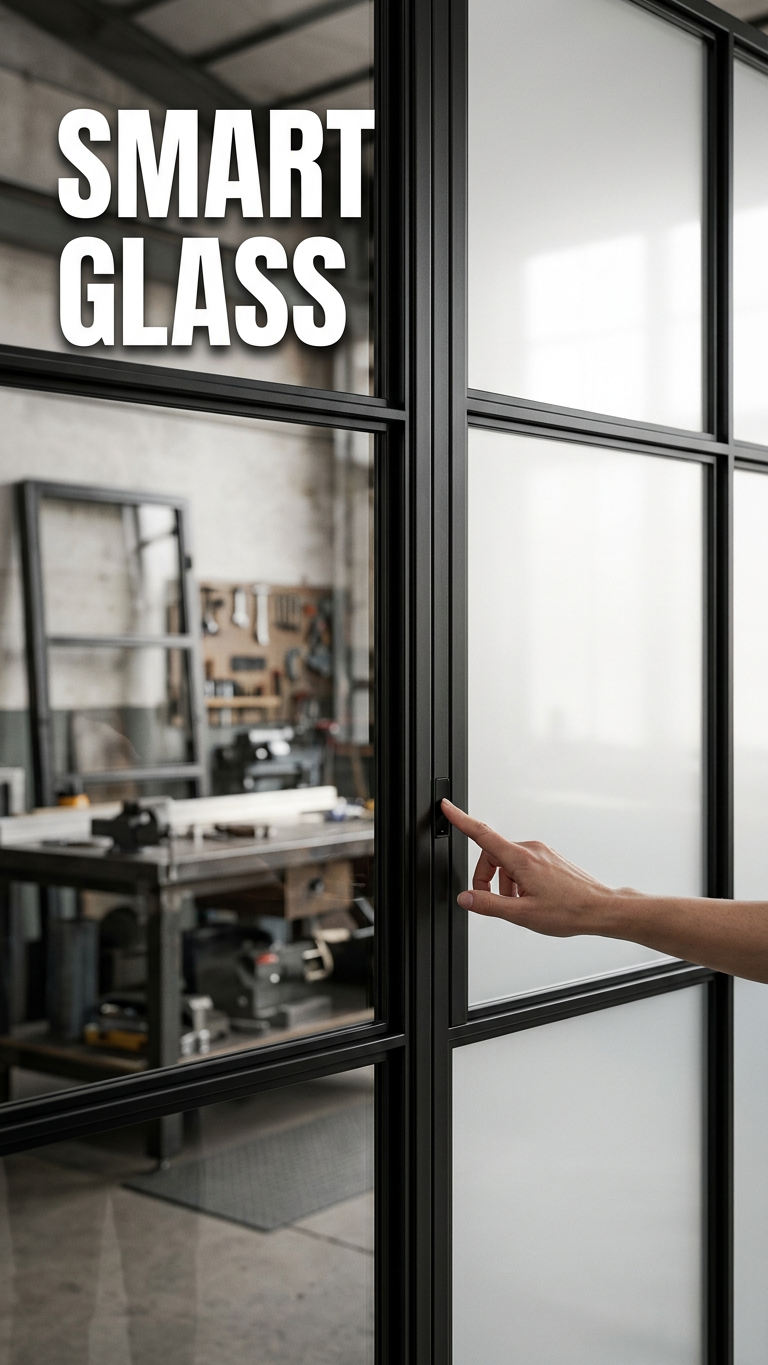
Smart Glass & Switchable Glass in Steel Doors and Windows: Design Freedom with On‑Demand Privacy
Privacy, daylight, and clean architectural lines often pull a project in different directions. Curtains and blinds interrupt minimal detailing, while fixed obscure glazing can compromise openness and visual connection. Smart glass—especially switchable privacy glass—offers a different route: clear transparency when daylight and views matter, instant opacity when discretion takes priority.
Within steel-framed glazing, smart glass unlocks a particularly compelling combination: Crittall-style slim-frame glazing, strong sightlines, and modern control of light and privacy. Bespoke steel doors, steel windows, partitions, and screens manufactured in Gdańsk, Poland by Portamet frequently form the architectural “skeleton” for projects that demand both elegance and performance, with supply for projects across Europe, the UK, and the USA.
What “Smart Glass” Means in Practice
Smart glass is an umbrella term covering multiple technologies that change light transmission characteristics in response to power, heat, or light. In architectural steel doors and windows, the most requested categories tend to be:
- Switchable privacy glass (PDLC): changes from translucent (private) to clear (transparent) via electrical current.
- Electrochromic glass: darkens or lightens gradually to control glare and solar gain.
- SPD (suspended particle device): transitions between tinted states quickly, with strong glare control.
- Thermochromic/photochromic solutions: react automatically to heat or UV, typically without wiring, but with less user control.
For steel-framed interior partitions, steel doors, and bathroom-adjacent glazing, switchable privacy glass is often the most practical choice, since the switch between private and clear is immediate and visually dramatic—ideal for spaces that need flexibility during the day.
How Switchable Glass Works (Without Over-Engineering the Explanation)
Most switchable privacy glass used in doors and windows relies on PDLC film (polymer dispersed liquid crystal). The PDLC layer sits between glass plies (or is used as an interlayer within laminated glass). In an unpowered state, the liquid crystals scatter light, producing a frosted, translucent appearance. When powered, the crystals align and allow light to pass through, creating a clear state.
Clear vs. Private: What Changes Visually
- Private (off): strong obscuration, high diffusion of light, reduced visual distraction, “softened” silhouettes at close distances depending on product specification.
- Clear (on): high transparency, maximum daylight, open-plan feel, strong lines of steel framing remain the key visual feature.
Switchable glass is sometimes described as “opaque,” but most PDLC products are best described as translucent in private mode, not a solid wall. For true blackout, additional layers or alternative strategies may be required.
Why Smart Glass Pairs Especially Well with Steel Frames
Steel is frequently selected for architectural glazing due to slim profiles, crisp geometry, and high stiffness. Smart glass strengthens those advantages:
1) Minimalism Without the “Window Dressing”
Blinds, curtains, and tracks add visual clutter—especially in Crittall-style grids where sightlines and symmetry are central to the design. Switchable glass preserves the clean look of slim-frame glazing while offering privacy on demand.
2) Daylight First, Privacy When Needed
Fixed obscure glass permanently sacrifices view and clarity. Switchable glazing allows a clear state during most of the day, keeping the spatial connection across rooms and corridors, then shifts to private mode for meetings, bathing, or focused work.
3) Premium Detail in High-Traffic Interiors
In hospitality, offices, clinics, and high-end residential interiors, fabric solutions collect dust, suffer wear, and can look tired quickly. Smart glass reduces moving parts in the room and keeps the visual focus on steel joinery and architectural proportion.
Common Applications for Switchable Glass in Steel Doors and Windows
Steel-Framed Internal Doors
Switchable panels in steel doors create flexible rooms: open and transparent for everyday use, then private for calls, consultations, or guest accommodation. Popular placements include home offices, studies, media rooms, and ensuite connections.
Steel Partitions and Screens
Boardrooms, meeting pods, and reception-adjacent spaces benefit from instant privacy without sacrificing daylight distribution across a floorplate. A steel-framed partition with switchable glass can function as both an architectural feature and an operational tool.
Bathrooms and Spa Zones
Bathrooms with borrowed light often struggle with the privacy-versus-daylight trade-off. Switchable privacy glass provides daylight to adjacent spaces while maintaining discretion when required. Steel framing adds a refined, modern edge aligned with contemporary spa aesthetics.
Healthcare and Clinical Environments
Privacy regulations and patient comfort often require fast transitions. Switchable glass can support dignified screening while maintaining staff visibility when appropriate. Proper specification of safety glass and cleaning-resistant finishes is essential.
Retail and Showrooms
Switchable glass can control what becomes visible from public areas—useful for VIP rooms, fitting areas, or back-of-house zones that occasionally need to present as part of the showroom.
Performance Considerations That Matter in Real Projects
Smart glass selection should go beyond the “wow” factor. A robust specification addresses light quality, durability, insulation, safety, acoustics, and control systems.
Visible Light Transmission (VLT) and Haze
PDLC in clear mode may carry a small increase in haze compared with standard clear glazing. Product selection should consider:
- Clarity in the on-state for sightlines and visual comfort.
- Uniformity in the off-state, avoiding patchiness or edge variation.
- Colour rendering, particularly near premium finishes and natural materials.
Thermal Performance: U-Value and Solar Control
Switchable privacy glass (PDLC) mainly changes privacy, not solar gain. For external steel windows and doors, a high-performance insulated glass unit (IGU) remains the foundation for energy efficiency:
- Low-E coatings for reduced heat loss.
- Argon or krypton fill where appropriate.
- Warm-edge spacers to reduce condensation risk.
- Thermally broken steel profiles to support modern energy standards while keeping slim sightlines.
For glare and overheating control, electrochromic or SPD may be more suitable than PDLC, or a hybrid strategy may be adopted (for example: solar control coatings plus PDLC for privacy).
Acoustic Performance
Steel-framed partitions are often selected for acoustic zoning. Smart glass can be integrated within laminated acoustic build-ups to improve speech privacy. Acoustic performance depends on the entire assembly: glass thickness, interlayers, seals, and frame detailing.
Safety and Compliance (Tempered, Laminated, and Impact Requirements)
Doors and low-level glazing typically require safety glass. Switchable layers are commonly integrated into laminated safety glass, and may be combined with toughened plies depending on risk assessment and local codes. Typical reference points include:
- Europe: EN standards for toughened and laminated safety glazing.
- UK: safety glazing locations under building regulations and relevant standards.
- USA: safety glazing requirements commonly aligned with ANSI Z97.1 and CPSC 16 CFR 1201, subject to jurisdiction and application.
Early coordination between glazing supplier, fabricator, and project team helps ensure correct certification for the intended location and use.
Specifying Switchable Glass in Steel Frames: Key Decisions
1) Single Panel vs. Insulated Glass Unit (IGU)
Interior partitions may use laminated switchable panels, while external steel windows and doors usually require an IGU for thermal performance. Switchable glass can be integrated into IGUs, but careful detailing is needed for wiring routes and edge conditions.
2) Wiring, Power Supplies, and Control Gear
Switchable glass requires power and control. Key items for specification include:
- Voltage and transformers (often driver units located in accessible service zones).
- Cable routing through frames, hinges, or adjacent construction.
- Access for maintenance without dismantling primary architectural elements.
- Load planning where multiple panels switch simultaneously.
Steel frames can conceal cabling effectively, supporting clean finishes. Coordination at shop-drawing stage prevents visible conduits and avoids conflicts with locks, closers, and hinge reinforcement.
3) Switching Methods: Wall Switches, Sensors, and Smart Home Integration
- Standard wall switch: simple, reliable, familiar interface.
- Remote control: useful for meeting rooms and multi-panel partitions.
- Occupancy or door sensors: automation for bathrooms or clinical spaces.
- Building management systems: integration for commercial projects.
For premium residential interiors, integration with common automation platforms can create scenes such as “meeting,” “movie,” or “night,” coordinating lighting, glazing privacy, and shading where present.
4) Panel Size, Divisions, and Visual Rhythm
Steel glazing often relies on a strong grid. With switchable glass, each pane may be independently switchable or grouped. Decisions to lock early include:
- One transformer per zone vs. multi-zone control for flexible layouts.
- Symmetry of switching to maintain a calm façade or partition rhythm.
- Consistency of busbar placement to avoid uneven visual cues across panes.
Detailing Matters: What Can Go Wrong (and How to Avoid It)
Smart glass failures are rarely about the concept and often about coordination. The following topics deserve attention during specification and fabrication.
Edge Conditions and Moisture Protection
Switchable layers are sensitive to moisture at edges. Correct sealing strategies and compatible glazing systems are essential, particularly within IGUs. Coordination with the switchable glass supplier on edge deletion, encapsulation, and sealant compatibility reduces risk.
Frame Tolerances and Glazing Clearances
Steel frames are precise, but movement exists in buildings. Adequate setting blocks, gaskets, and tolerances prevent stress concentrations at glass edges. For doors, slamming forces and closer settings should be considered during hardware selection.
Heat Build-Up and Exposure
Direct sun on certain switchable products can increase temperatures. External use should consider solar exposure, glass build-up, and supplier limits. For high-sun façades, alternative smart glass types or additional solar control coatings may be preferable.
Uniformity and Aesthetics
Visual expectations should be aligned early. In private mode, PDLC typically creates an even diffusion, but slight variations can appear under certain lighting angles. Sample review in project-like lighting conditions helps confirm acceptance.
Smart Glass vs. Traditional Privacy Solutions
Blinds and Curtains
- Pros: low initial cost, broad style choices.
- Cons: visual clutter, dust, wear, reduced “architectural” feel, awkward pairing with slim steel grids.
Fixed Frosted or Patterned Glass
- Pros: simple, no wiring, stable long-term.
- Cons: permanent loss of clarity and view, limited flexibility for multi-use rooms.
Switchable Privacy Glass
- Pros: instant privacy, maintains minimalism, supports flexible planning, strong compatibility with steel-framed partitions.
- Cons: higher cost, needs power and controls, requires careful edge and wiring detailing.
For projects prioritising adaptable layouts and refined detailing, switchable glass often justifies the added coordination effort.
Design Ideas: Where Switchable Steel Glazing Creates the Most Impact
Kitchen-to-Utility or Pantry Screens
Visual calm in open-plan living can be preserved by switching a steel screen to private mode during busy moments, then returning to clear for an expansive feel.
Home Office Fronts in Heritage Renovations
Steel-framed glazing is frequently introduced into period homes to add contemporary contrast without heavy structural intervention. Switchable glass supports working privacy while keeping borrowed light flowing through corridors.
Hotel Ensuite Windows and Doors
Ensuite glazing adds a boutique feel. Switchable privacy avoids curtains inside wet zones and keeps the steel grid as the defining feature.
Conference Rooms and Executive Offices
Transparency supports an open culture; instant privacy supports confidential conversations. Zoned switching across multiple panes can create gradients of privacy while maintaining a cohesive steel grid.
Steel Frames and Smart Glass: Technical Compatibility Notes
Steel-framed systems can be engineered for smart glass without compromising slim sightlines, provided that fabrication planning accounts for power and glazing build-up thickness.
- Glazing bead and gasket design must accommodate laminated and/or IGU thicknesses commonly used with smart layers.
- Thermally broken steel profiles are recommended for exterior steel windows and doors to support energy performance goals.
- Hardware coordination matters on doors: hinge routes, lock cases, and closers must leave space for cable paths and strain relief.
- Finish selection (powder coating, protective systems) should consider long-term interior humidity where bathroom use is planned.
As a premium manufacturer of bespoke steel doors and steel windows, Portamet supports custom detailing where smart glass integration is required, including slim-frame glazing proportions aligned with Crittall-style aesthetics. Custom-made production enables project-specific alignment of mullion positions, panel sizes, and control zoning, with international supply supporting projects across Europe, the UK, and the USA.
Questions to Resolve Early in the Specification
- Primary goal: privacy only, or glare/solar control as well?
- Location: internal partition, internal door, external window, or external door?
- Glass build-up: laminated only, or IGU with Low-E and gas fill?
- Safety requirements: impact classification and code compliance for the region.
- Control strategy: single switch, multi-zone, automation, or BMS integration?
- Service access: driver location and maintenance pathway.
- Aesthetic expectations: acceptable haze, private-mode appearance, and cable concealment.
Early answers reduce redesign risk and protect timelines, particularly on bespoke steel frames where fabrication follows approved shop drawings.
Cost Perspective: What Typically Drives Budget
Switchable glass pricing varies by region and supplier, but budgets are usually influenced by:
- Panel area and quantity.
- IGU complexity (Low-E coatings, acoustic layers, warm-edge spacers).
- Zoning and controls (multi-zone switching, automation, BMS integration).
- Door hardware complexity where powered leaves are required.
- Installation coordination (electrician scope, containment routes, commissioning).
Value tends to increase most in projects where smart glass replaces multiple elements at once—such as blinds plus frosted film plus layout compromises—while enhancing the architectural statement of steel-framed glazing.
Maintenance and Longevity
Switchable glass is generally low-maintenance from a daily-use perspective. Practical operational guidance includes:
- Cleaning: non-abrasive methods suitable for architectural glass; avoid aggressive solvents unless confirmed compatible with the switchable layer and seals.
- Electrical components: drivers and controllers should remain accessible and ventilated where required.
- Commissioning: correct setup reduces flicker risk and ensures uniform switching across zones.
Long-term performance depends heavily on quality of glass manufacture, edge protection, and installation discipline—especially in wet areas or exterior conditions.
Choosing the Right Partner for Bespoke Steel-Framed Smart Glass
Smart glass is most successful when frame fabrication, glazing specification, and electrical planning move together. Bespoke steel frames offer flexibility, but that flexibility must be supported by accurate detailing, clear responsibilities, and confirmed lead times for both steelwork and glass.
Portamet manufactures bespoke steel doors, steel windows, partitions, and screens in Gdańsk, Poland, with slim steel profiles, strong craftsmanship, and options designed to support modern thermal requirements where applicable. Supply for projects across Europe, the UK, and the USA enables consistent steel-framed design language across international portfolios, including Crittall-style and other slim-frame glazing aesthetics.
Next Steps for Projects Considering Switchable Glass
Project feasibility is best confirmed with a short technical brief covering location (internal or external), approximate panel sizes, preferred grid layout, performance targets (thermal and acoustic), and desired switching method. With those fundamentals defined, a coordinated proposal can align steel frame detailing, smart glass build-up, and control strategy.
Product exploration, technical guidance, and quotations for bespoke steel doors and windows with smart or switchable glass integration can be requested through Portamet, supporting design teams and clients across Europe, the UK, and the USA.