What makes a steel door feel truly “high-end” the moment it closes—sound, weight, precision, or the way light frames the room beyond? In reality, it is all of these details working together, engineered and crafted with intent. Premium steel doors are not simply fabricated; they are designed as architectural elements that must perform for decades while looking effortlessly refined.
Portamet, a premium Polish manufacturer based in Gdańsk, specialises in bespoke steel doors, steel windows, partitions, and screens made to order. With projects delivered across Europe, the UK, and the USA (as well as Canada and the Middle East), production standards must meet demanding design expectations and rigorous performance requirements. The result is steel-framed glazing that pairs slim sightlines and Crittall-style aesthetics with modern durability and thermal efficiency.
What “High-End” Means in Steel Doors
The term “high-end” gets used often, but in steel-framed doors it has a specific meaning: consistency, precision, and performance at a fine level of detail. A luxury finish is not only about colour or hardware—it is also about how the door is built internally, how the frame holds tolerance, and how the glazing and seals behave in daily use.
High-end steel doors should open smoothly, align perfectly, and close with a clean, confident contact. Sightlines should be slim and symmetrical, with proportions that suit the architecture. Equally important, the system must be robust and stable—resisting warping, racking, and movement over time.
Key qualities that define premium steel doors
Precision engineering: tight tolerances, clean mitres, consistent gaps, and reliable alignment.
Durability: steel structure designed for longevity, with appropriate corrosion protection and finishes.
Comfort: refined operation, thoughtful thresholds, and effective sealing where required.
Design integrity: slim-frame glazing that supports minimalist, industrial, and contemporary interiors.
Project-fit customisation: made-to-measure sizes, opening configurations, and glazing choices.
From Concept to Commission: Starting with the Brief
Every bespoke steel door begins with a set of decisions that shape both aesthetics and performance. In high-spec residential projects, the brief may focus on refined Crittall-style proportions, minimal sightlines, and a particular colour tone. In hospitality or commercial interiors, priorities may include traffic durability, acoustic comfort, and robust hardware suited to frequent use.
Portamet’s approach starts by understanding how the doors will be used, where they will sit in the building envelope, and what visual language the project needs. This initial clarity reduces redesign later and ensures the finished doors support the architecture instead of fighting it.
Typical inputs at the briefing stage
Location and function: internal partitions, external doors, entrance sets, or terrace connections.
Style direction: industrial, minimalist, heritage-inspired, or contemporary.
Configuration: single, double, pivot, sliding, fixed side lights, fanlights, or corner solutions.
Performance needs: thermal efficiency expectations, acoustic requirements, and security considerations.
Glazing plan: clear, low-iron, reeded/fluted, bronzed, laminated safety glass, or insulated units where appropriate.
Design Engineering: The Hidden Work Behind Slim Sightlines
Slim-frame glazing is visually light, but it demands serious engineering. Narrow steel profiles must remain stable, hold glass securely, and maintain consistent alignment across the entire assembly. The design phase balances sightline goals with structural logic—especially on large doors, tall partitions, or multi-panel compositions.
This is where bespoke manufacturing matters most. A made-to-order steel door can be proportioned to the room, matched to surrounding details, and coordinated with adjacent steel windows or screens. Rather than forcing a project into standard sizes, the system can be tailored to suit ceiling heights, floor build-ups, and architectural lines.
Design decisions that affect both aesthetics and performance
Profile selection: choosing the right steel sections for the desired visual weight and span.
Panel proportions: setting a grid that looks balanced and intentional—especially on double doors.
Hardware strategy: hinges, handles, locks, and closers chosen for durability and feel.
Threshold detailing: flush transitions for interiors or performance-oriented thresholds where needed.
Glazing specification: safety, privacy, and energy performance considered in a single package.
Materials and Steel Selection: Building a Door That Holds Its Shape
Steel is chosen for a reason: strength with slenderness. Compared with bulkier framing materials, steel can deliver narrow frames that still feel solid. But “steel” is not one uniform material choice—profiles, thicknesses, and construction methods determine how the final product behaves.
In premium steel doors, the objective is not simply to produce a rigid frame; it is to produce a stable, durable assembly with refined details and consistent geometry. This demands careful material selection and production discipline, particularly where glazing interfaces, hinge loads, and lock areas require reinforcement.
Where material strategy matters most
Large-format doors: tall and wide leaves need stiffness to prevent sag and maintain alignment.
Multi-panel compositions: consistent sightlines depend on uniform profile behaviour across panels.
High-use environments: hospitality and commercial spaces require robustness at touchpoints.
External conditions: exterior doors and steel windows demand appropriate thermal and protective solutions.
Precision Fabrication: Cutting, Machining, and Fit
The distinctive look of steel doors—crisp lines, clean corners, and a graphic grid—relies on accuracy at every stage. The cutting and machining phase sets the foundation for everything that follows. If frames are not perfectly square or if joinery is inconsistent, the door will show it: uneven gaps, irregular sightlines, and compromised sealing.
In high-end production, accuracy is not a single step; it is a culture of measurement and control. Frames, mullions, and transoms must align as a system, not as individual parts. Hardware preparation is equally important, because hinges and locks demand exact placement to deliver a smooth feel and long-term reliability.
Why tolerances matter in slim-frame glazing
Visual quality: consistent reveals and symmetry are immediately noticeable in steel-framed designs.
Operational feel: precise hinge geometry supports smooth opening and a solid close.
Glazing performance: accurate rebates and seating improve glass stability and sealing.
Installation fit: made-to-measure frames should sit cleanly within prepared openings.
Welding and Assembly: Strength Without Bulk
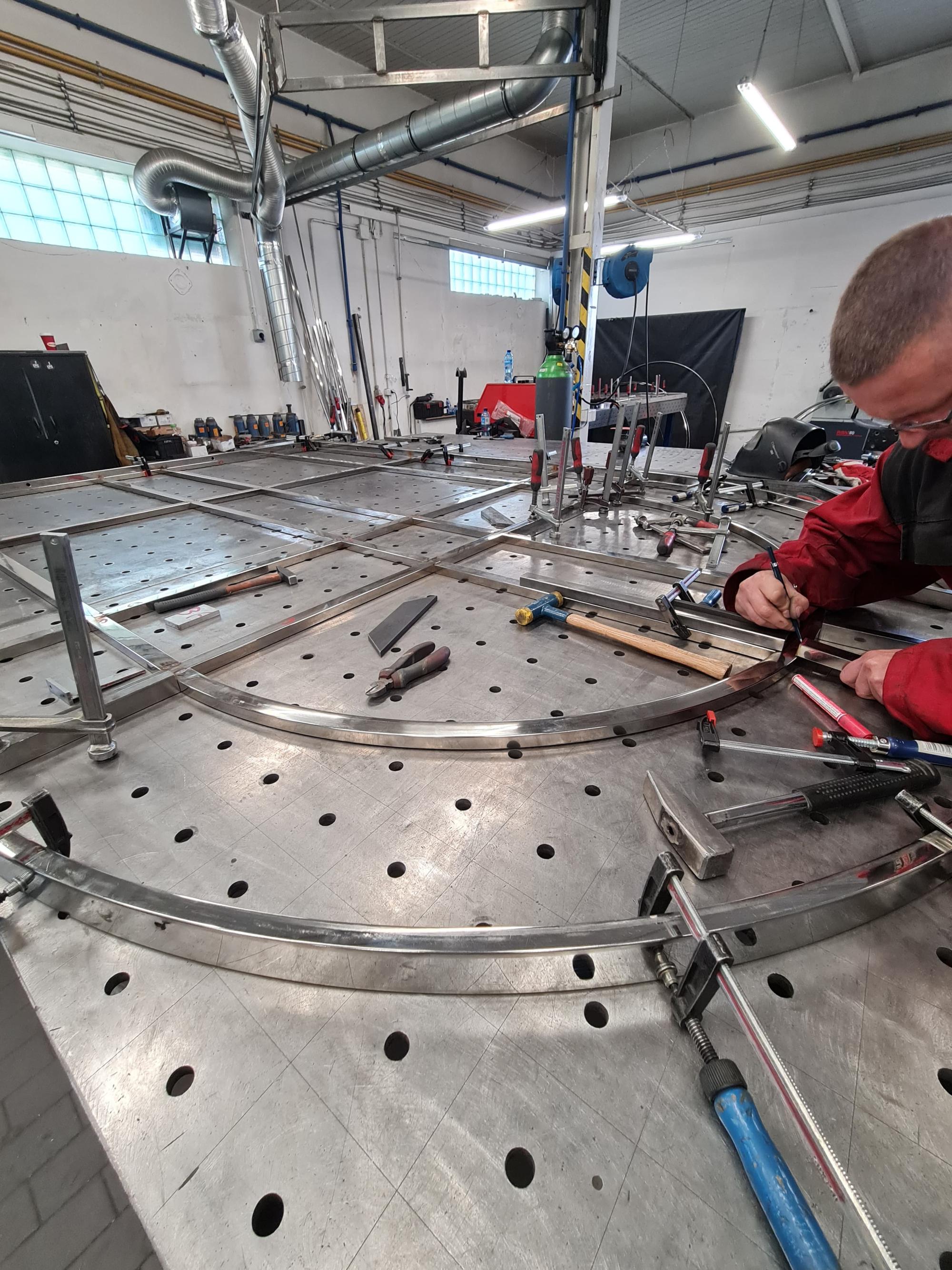
Welding is where steel doors gain their permanent structure. The challenge is to produce joints that are structurally sound while preserving the slim, refined aesthetic. Excess material, distortion, and inconsistent finishing can quickly undermine the minimalist appeal that makes steel-framed doors so popular.
Careful assembly ensures corners remain crisp and frames stay true. Door leaves must be built to maintain geometry under their own weight, and internal reinforcement may be used in areas of concentrated load such as hinge and lock zones. The goal is not just strength, but strength that remains invisible—so the finished door looks clean and intentional.
Common craftsmanship priorities during assembly
Squareness and flatness: essential for consistent gaps and reliable latch engagement.
Controlled heat input: helps minimise distortion and keeps profiles visually sharp.
Reinforcement where needed: improves longevity without increasing sightline thickness.
System consistency: matched dimensions across doors, screens, and steel windows in the same project.
Surface Preparation: The Step That Separates “Good” from “Exceptional”
Even the best-built frame can lose its premium feel if the finish reveals imperfections. Surface preparation is often the difference between an average product and a high-end one. Steel must be cleaned and prepared properly before finishing so that coatings adhere consistently and the final appearance remains smooth and resilient.
Premium steel doors are frequently specified in dark tones—classic black, anthracite, deep bronze, or custom colours. These shades can be unforgiving: any waviness, poor sanding, or inconsistent coating becomes visible in certain light. A high-quality finishing process keeps the door looking sharp from every angle.
What surface preparation influences
Visual uniformity: a smooth, consistent finish across frames and glazing bars.
Corrosion resistance: preparation supports long-term protection, especially near coastal or humid environments.
Touch experience: steel doors should feel refined in the hand, not rough or uneven.
Project cohesion: matching the finish across steel doors and steel windows helps unify interiors.
Finishing: Colour, Texture, and Long-Term Durability
Finishing is where the door’s personality becomes visible. The same steel profile can feel stark and industrial in a matte black, warm and architectural in a bronze tone, or understated in a soft neutral. Designers increasingly use steel-framed glazing as a way to define space without building heavy walls, and finish selection plays a central role in how that boundary reads.
In high-end projects, finish is not chosen from a limited palette—it is coordinated with flooring, cabinetry, lighting metals, and wall tones. A bespoke manufacturer can support this level of coordination, ensuring steel doors and partitions sit comfortably within the wider design scheme.
Finish considerations for design-led projects
Gloss level: matte finishes feel modern and reduce reflections; satin can feel richer in low light.
Colour matching: coordinated tones help steel glazing integrate with other architectural elements.
Texture: subtle texture can hide fingerprints and small marks, supporting everyday practicality.
Consistency across elements: doors, screens, and steel windows should read as one family.
Glazing: Safety, Privacy, and Light Control
Glass selection is not only a visual decision. It affects safety, acoustics, privacy, and—when external systems are involved—thermal comfort. Many steel-framed doors and screens sit inside the home, dividing spaces while maintaining daylight flow. In these cases, glass can be chosen to balance openness with subtle separation.
Reeded or fluted glass remains popular in contemporary interiors, offering privacy without blocking light. Clear glazing supports maximal transparency and crisp sightlines. Laminated safety glass can be specified where impact resistance is desirable, and specialist options can address acoustic priorities in busy homes or commercial settings.
Popular glazing choices for steel-framed interiors
Clear toughened glass: clean, modern transparency and a crisp industrial look.
Reeded/fluted glass: privacy with light diffusion for bathrooms, offices, or kitchens.
Bronze or smoked tints: adds warmth and mood, often paired with bronze-toned frames.
Laminated glass: enhanced safety and, in some configurations, improved acoustic behaviour.
Hardware and Detailing: Where Daily Experience Is Won
The daily experience of a steel door is shaped by hardware. Handles, hinges, locks, and latches are the touchpoints that determine whether the door feels effortless or frustrating. Even a visually perfect door can feel “off” if the hardware is not matched to the weight and usage pattern.
High-quality steel doors should open without drag, close cleanly, and align consistently. Hardware selection and installation accuracy both matter. This is especially true for double doors, pivot designs, and larger-format leaves where weight distribution and precision become critical.
Details that elevate the user experience
Handle feel: comfortable grip and solid action that matches the door’s quality.
Hinge performance: stable movement and alignment over time.
Lock integrity: reliable engagement and smooth operation.
Stop and seal detailing: a controlled close and reduced rattling in everyday use.
Thermal Efficiency: Modern Expectations for Steel-Framed Systems
Steel doors are often associated with heritage industrial styling, but modern projects demand more than looks. Where steel doors or steel windows form part of the building envelope, thermal performance becomes essential. Contemporary steel-framed systems can be engineered to support better energy efficiency while retaining slim profiles and clean lines.
This is particularly relevant for international projects across different climates—from the UK’s variable weather to parts of the USA where heating and cooling loads can be significant. Thoughtful specification—covering glazing, seals, and system design—helps ensure that steel-framed glazing remains comfortable and practical, not just visually striking.
Performance-minded factors to consider
Glazing type: insulated and performance glazing where external applications require it.
Sealing strategy: improved comfort through reduced draughts and better closure control.
System choice: selecting a design that aligns with the project’s thermal goals.
Build-up coordination: integration with surrounding wall and threshold details.
Quality Control: Checking the Details That Clients Actually Notice
Quality control in bespoke manufacturing is more than a final glance before shipping. It is a series of checks that confirm the door will look right, operate correctly, and install smoothly. The most visible signs of quality are often simple: consistent gaps, straight lines, smooth finish, and symmetrical geometry.
In steel-framed glazing, the eye naturally follows the grid—meaning any small misalignment stands out. A disciplined quality process ensures the visual rhythm remains crisp and that the finished product reflects the designer’s intent.
Typical checks that protect end results
Alignment and squareness: verifying consistent reveals and door geometry.
Operation: confirming smooth opening, stable closing, and correct latch engagement.
Finish inspection: checking consistency, coverage, and surface quality under good lighting.
Glazing fit: ensuring glass sits securely and cleanly within the frame.
Hardware verification: confirming correct placement and secure installation.
Packaging and International Delivery: Protecting Bespoke Work in Transit
Bespoke steel doors are architectural pieces, and shipping them safely is part of the craftsmanship story. Protective packaging must guard against impacts, abrasion, and moisture during transport. This is especially important for international delivery, where products may pass through multiple handling points before arriving on site.
Portamet manufactures in Poland and supplies bespoke steel doors and steel windows to clients across Europe, the UK, and the USA, with additional reach to Canada and the Middle East. That geographic spread requires a consistent approach to protecting finished surfaces and maintaining identification so that installers can match each piece to the correct opening.
Why logistics matters for high-end steel doors
Finish preservation: premium coatings should arrive unmarked and ready for installation.
Component organisation: hardware and glazing elements must remain complete and traceable.
Site efficiency: clear labelling and careful packing reduce installation delays.
Project confidence: predictable delivery helps keep construction schedules on track.
How Steel Doors Shape Interiors: Design Value Beyond the Frame
Steel-framed doors and partitions have become a design staple for good reason. They define zones without sacrificing light, allowing kitchens to connect to dining rooms, home offices to feel separated yet open, and circulation spaces to gain architectural interest. The best steel doors feel like part of the building’s structure rather than a decorative add-on.
In modern renovations, steel doors can replace heavy walls and introduce a cleaner spatial flow. In new builds, they support minimalist architecture by adding fine lines and proportion. With bespoke steel frames, dimensions and panel layouts can be tuned to the project, ensuring the grid complements ceiling heights, wall openings, and furniture lines.
Where steel-framed glazing works particularly well
Kitchen separation: controlling noise and odours while keeping daylight and connection.
Home offices: creating focus without losing a sense of space.
Stair halls and landings: adding rhythm and safety without visual heaviness.
Hospitality interiors: durable, design-led partitions that handle daily use.
Choosing a Bespoke Manufacturer: What to Look For
Not all steel doors are created equal. Some systems are designed primarily for a look, while others deliver a more complete balance of aesthetics, longevity, and performance. The right manufacturer should be able to speak confidently about proportion, fabrication, finish, glazing choices, and how the doors will behave after years of use.
Bespoke capability matters when openings are non-standard, when sightlines must align across multiple elements, or when a project demands a specific finish and hardware set. European craftsmanship, paired with modern production standards, helps deliver the precision required for slim-frame glazing that feels truly architectural.
A practical checklist for specifiers
Made-to-order production: flexibility on sizes, layouts, and configurations.
Slim profiles: refined sightlines without compromising structural stability.
Finish standards: consistent coating quality and attention to surface preparation.
System knowledge: guidance on glazing, seals, and use-case suitability.
International project readiness: reliable packaging and delivery experience for the UK, USA, and Europe.
Closing Thought: Craftsmanship You Can See—and Feel
High-end steel doors succeed on two levels: they create a strong architectural statement, and they quietly perform every day. Crisp sightlines, stable frames, quality finishes, and well-chosen glazing come together to form doors that elevate interiors and stand up to real life.
Portamet’s bespoke steel doors and steel windows are crafted in Gdańsk, Poland, with a focus on slim-frame glazing, durability, and design-led customisation for projects across Europe, the UK, and the USA. Exploration of Portamet’s steel-framed systems or requesting a tailored quote can be the next step toward bringing a refined Crittall-style or contemporary steel aesthetic into a project.